Cosmetic Peat for Skin: What the Scientific Evidence Actually Shows
The short answer: there is credible evidence that peat and peat-derived humic substances can affect processes relevant to skin inflammation, antimicrobial activity, hydration, and itching — but the clinical evidence is still limited. Human studies exist for conditions including psoriasis, eczema, seborrheic dermatitis, and dandruff, yet most are small, uncontrolled, or non-blinded, and large placebo-controlled trials are still missing.
By Cosmetic Peat Editorial Team Updated September 2026
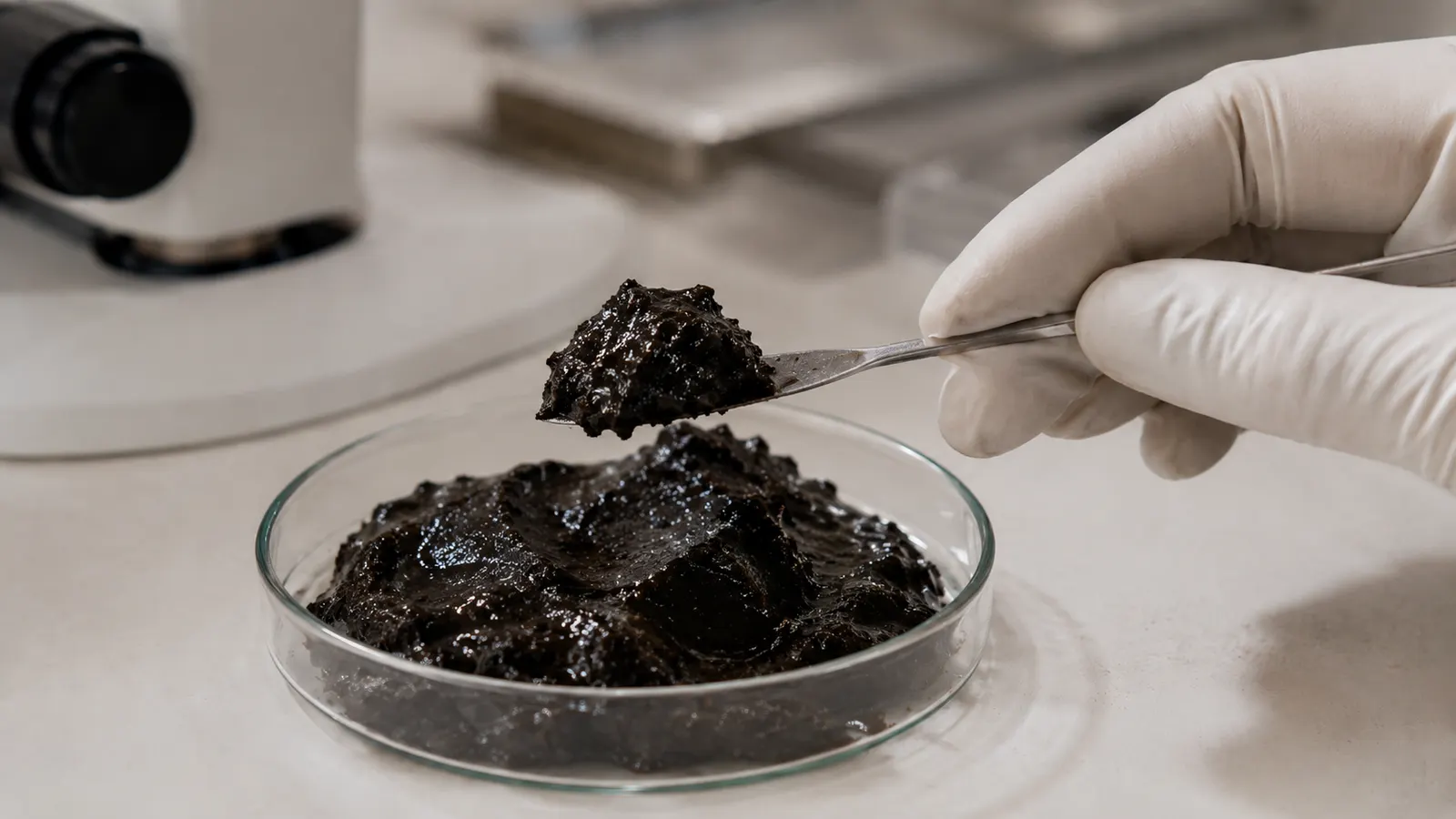
Peat has been used in European spa medicine for more than two centuries, but the scientific literature behind it is scattered and rarely reviewed in English as a whole. This page brings it together: what has been studied, how strong the evidence actually is, and where the gaps remain.
Peat is a complex natural mixture, not a single active ingredient. Its main bioactive fraction is humic substances — including humic and fulvic acids — and composition varies substantially between deposits and processing methods. These constituents have been studied for anti-inflammatory, antimicrobial, antioxidant, and skin-conditioning activity, although the strength of evidence differs considerably between these effects — which is exactly what the sections below break down, topic by topic.
Human studies exist for psoriasis, eczema, seborrheic dermatitis, dandruff, and dry skin — the clearest signals are in scalp and inflammatory-skin research, though most studies are small, uncontrolled, or non-blinded.
Humic and fulvic substances show anti-inflammatory, antimicrobial, and other biologically relevant activity in vitro and in animal models — more consistently than the clinical evidence.
No large, blinded, placebo-controlled trial has established peat as a treatment for psoriasis or atopic dermatitis.
Peat is not chemically uniform — origin, decomposition, and processing all affect its composition.
For context: balneotherapy (therapeutic treatment with natural agents such as mineral water, mud, or peloids like peat) has its strongest evidence base in osteoarthritis (multiple RCTs) — a musculoskeletal use outside this skin-focused review.
What Can We Reasonably Conclude?
- Some small human studies report improvements in inflammatory skin and scalp symptoms.
- Scalp moisture, scaling, and seborrheic symptoms have been measured objectively in human studies.
- Anti-inflammatory activity
- Antimicrobial activity
- Histamine-related (mast-cell) effects
- Antioxidant activity
- Hyaluronidase inhibition
- That peat treats psoriasis or eczema
- Clinically meaningful anti-aging effects in humans
- The optimal topical dose
- Long-term benefits from everyday cosmetic use
Evidence at a Glance
Evidence levels below use the same conservative scale applied throughout this site — see how we grade evidence. Each row's level computes automatically from that condition's own claims data on this site, so it can't drift from what the linked page itself shows. This table focuses on skin; joint inflammation/osteoarthritis is included at the bottom for reference only, since it's the one topic here that reaches "Substantial."
Clinical observations, SCORAD-based cohort reports, and reviews of peat balneotherapy and topical application.
Mouse models of atopic/allergic dermatitis; in vitro mast-cell and keratinocyte assays.
One of the better-studied skin conditions for peat, but no large blinded RCT exists yet.
An open (non-blinded) trial of daily peat application, cohort observations, and one systematic review of balneotherapy for psoriasis broadly.
Immunomodulatory mechanism studies relevant to autoimmune skin inflammation.
The systematic review supports balneotherapy generally; peat-specific RCTs are still missing.
A study of 82 patients (peat + mineral-water mask vs. base cream), summarized in a 2013 review, reported a significant reduction in symptoms.
Antifungal activity of humic substances against Malassezia in vitro.
The strongest controlled human comparison on this page — though against a base cream, not an active antifungal.
A 12-week scalp-treatment study reported scalp moisture rising from roughly 27 to 55 units, with decreased sebum and squame counts.
Antifungal activity relevant to Malassezia-driven dandruff.
The study measured general scalp health rather than dandruff specifically, and reporting does not specify a control group.
A 10-day face-mask trial reported measurably softer, smoother skin; a separate study measured skin moisture (hygroscopy) nearly doubling after peat treatment.
Humectant/occlusive mechanism studies; consistent hydration findings across cosmetology reviews.
No randomized trial has tested peat specifically for dry skin, but the outcome measured (skin feels and tests more hydrated) is a lower bar than a medical claim.
No dedicated human trials identified.
Antibacterial activity against gram-positive bacteria relevant to acne, in vitro.
The weakest-evidenced skin topic on this page — a plausible mechanism, but no human data yet.
No modern human trial identified for processed cosmetic peat.
Rat wound model: fibroblast proliferation ~3× control, angiogenesis ~3.5× control; in vitro scratch-assay evidence.
Fresh sphagnum moss has real documented history as a WWI-era wound dressing — that is a different, unprocessed material, and historical context rather than clinical evidence for modern cosmetic peat products.
A 10-day face-mask trial and a peloid clinical trial reported small improvements in skin softness, hydration, and elasticity — not wrinkle depth specifically. The only data on wrinkle reduction itself is a 5-subject manufacturer trial, unpublished and not peer-reviewed.
Hyaluronidase inhibition (protects existing skin hyaluronic acid); antioxidant and collagen-relevant mechanisms.
Deliberately graded below the linked condition page’s own rating: that page’s "Moderate" reflects real hydration/elasticity data (see Hydration / Barrier Support above), but visible wrinkle reduction specifically has no peer-reviewed human data behind it yet.
Multiple RCTs (Evcik 2007, Tefner 2013) and a systematic review of 13 RCTs/QRCTs (Keilani 2025); an Estonian trial reported 53% pain reduction and 33% mobility improvement in hand OA (Orru 2007), with a 17% dropout rate.
Overlaps with peat's general anti-inflammatory mechanisms (cytokine suppression); joint-specific mechanistic study is limited relative to the human trial data itself.
Included for reference, not as a skin claim: this is peat/peloid balneotherapy for a musculoskeletal condition, outside this page's skin focus — see What Human Studies Show below. It's the one topic on this site that reaches "Substantial."
Evidence levels should not be read as strength of belief. "Moderate" is real evidence with real limitations — not a weak result, and not a strong one. See our Editorial Policy for exactly how these tiers are defined and computed.
What Human Studies Show
The strongest human studies behind the skin ratings above. Study design details are stated only where the available source specifies them — "not reported" means exactly that, not an assumption.
Finding: Symptoms decreased significantly more in the peat group than the base-cream comparator.
Limitation: We have not obtained the original publication (Journal of Plastic Dermatology 5(3):293-298, 2009) — this description relies on its citation in Übner 2013 and the paper's own title, not a direct review. The comparator was a base cream, not an active antifungal, and the intervention combined peat with mineral water, so the contribution of peat alone can't be isolated.
Finding: Scalp moisture rose from roughly 27 to 55 units; sebum and squame counts decreased.
Limitation: No control group specified in the available summary. Not designed as a condition-specific (e.g. dandruff) trial.
Finding: Itch relief and earlier pustule resolution reported with daily peat application.
Limitation: Non-blinded design — open trials are more prone to placebo and observer bias than blinded ones.
Supported by a broader systematic review of balneotherapy for psoriasis (Jazani 2022), which the Wollina 2009 finding above sits within.
Osteoarthritis — the strongest overall evidence base, outside this page's skin focus. Multiple RCTs (Evcik 2007, Tefner 2013) and systematic reviews of RCTs/QRCTs (Keilani 2025) support peat/peloid balneotherapy for knee and hand osteoarthritis. A 2021 PRISMA meta-analysis pooling 26 mud/pelotherapy studies and 15,123 patients (Munteanu 2021) found osteoarthritis to be the single largest pathology category treated — the only source on this page that performs actual statistical pooling rather than a systematic or narrative summary. An Estonian trial reported a 53% pain reduction and 33% mobility improvement in hand OA (Orru 2007) — though with a notable 17% dropout rate (4 of 23 participants), a limitation worth stating plainly.
Wound healing is a separate case worth flagging explicitly. Fresh sphagnum moss has a genuine, well-documented history as a WWI-era wound dressing. But sphagnum moss and processed cosmetic peat are related, not equivalent, materials — the historical dressing use should not be read as clinical evidence for modern cosmetic peat products, which currently have no dedicated human wound-healing trial (see Evidence at a Glance above).
Common limitations across this human evidence: most studies are cohort designs, open trials, or clinical observation rather than large blinded RCTs; sample sizes are often small (tens, not hundreds, of participants); and it is frequently difficult to separate peat-specific effects from the general benefits of a structured spa treatment course (rest, routine, climate change, practitioner attention).
What Laboratory Studies Show
Laboratory and animal research provides the mechanistic explanation for why peat's clinical observations make biological sense. Key findings behind the ratings above:
Humic and fulvic acids suppressed inflammatory cytokines (TNF-α, IL-1β, IL-6) in vitro and in mouse models of atopic and allergic contact dermatitis.
Fulvic acid inhibited histamine release and β-hexosaminidase activity from mast cells — pathways relevant to allergic inflammation and itching, not yet shown to work as an antihistamine in humans.
Of 81 natural humic acid preparations tested against a microorganism panel, 57 showed antimicrobial activity in vitro.
In a rat wound model, a 0.5% fulvic acid poultice produced roughly 3× the fibroblast count and 3.5× the angiogenesis of control — an animal result, not yet tested in a human wound.
Hyaluronidase inhibition by humic substances is referenced in Estonian research literature (Hinn 2026, citing Efert 2018) — but Efert 2018 itself hasn't been independently located or verified, and no dedicated in-vitro hyaluronidase assay using purified humic acid has been published. Treat this as a plausible mechanism traced to unverified secondary literature, not a confirmed one.
Fulvic acid permeated excised human skin ex vivo — evidence that topical penetration is physically possible under lab conditions, not a measurement of real-world absorption.
These findings establish biological plausibility, not clinical effectiveness in humans.
Safety and Limitations
Composition varies significantly. Humic acid content ranges from roughly 10–40% of peat dry mass depending on origin and processing; different national methods for measuring fulvic acid content can disagree by 5–10× on comparable material. No international standard exists for measuring humic substance content in cosmetic peat, which makes cross-product and cross-study comparison difficult.
Heavy metals and contamination. Because peat is a natural material, contaminant testing matters. Peat can accumulate lead, cadmium, mercury, arsenic, and chromium from atmospheric deposition and groundwater. EU cosmetic law requires finished products to be safe, and technically unavoidable traces of prohibited substances may only be present under the conditions set by Regulation (EC) No 1223/2009 — responsible cosmetic-peat sourcing includes contaminant testing and a documented safety assessment, not just a general assumption of safety from natural origin.
Microbiological safety. Raw peat can harbor soil microorganisms, including rare pathogens such as Sporothrix schenckii. Processing (heat treatment, pH adjustment, preservation) reduces microbial load. ISO 17516 provides internationally recognised microbiological limits that can be used when assessing the microbiological quality of a finished cosmetic product.
Contraindications. Hot peat baths and full-body wraps are contraindicated in pregnancy (hyperthermia risk) and in unstable cardiovascular conditions (vasodilation and cardiac stress from full immersion at 38–42°C). Non-sterile peat preparations should not be applied to open wounds or broken skin — see the wound-healing note above on why historical sphagnum use doesn't change this for modern processed peat.
Allergenicity. Reported contact allergy to humic or fulvic acids is rare in the dermatological literature, though formal allergenicity testing of purified peat fractions remains limited. Patch testing is reasonable practice before first use, particularly for sensitive or allergy-prone skin.
Cosmetic vs. medical use. Cosmetic products legally cannot claim to treat, cure, or prevent disease. Claims about soothing, calming, or conditioning skin are cosmetic claims; claims about treating psoriasis or eczema are medical claims requiring a different regulatory pathway. This page describes research findings, not medical advice, and does not replace a dermatologist's guidance for a diagnosed skin condition.
What We Still Don't Know
Six questions the current research cannot yet answer.
For peat vs. placebo in atopic dermatitis (SCORAD outcomes) and psoriasis (PASI outcomes) — currently absent. The existing evidence is cohort studies and open trials.
Different national methods for measuring humic/fulvic acid content can disagree by 5–10× on comparable material — a harmonized standard would make cross-study comparison meaningful.
Laboratory work shows dose-dependent effects and ex vivo skin permeation, but what concentration actually reaches the dermis during a real topical application is unknown.
Antioxidant and hyaluronidase-inhibition mechanisms are established in vitro; large, controlled human measurements (elasticity, wrinkle depth, collagen density) do not yet exist.
Microbial dysbiosis is implicated in acne, eczema, and seborrheic dermatitis, and humic/fulvic acids affect microbial populations elsewhere — an unstudied but potentially relevant mechanism.
For daily-use cosmetic products, beyond the single-course clinical-trial safety data currently available.
Frequently Asked Questions
Does peat actually work for skin?
There is credible evidence that peat and peat-derived humic substances affect processes relevant to skin inflammation, antimicrobial activity, hydration, and itching — but the clinical evidence is still limited. Human studies exist for conditions including psoriasis, eczema, seborrheic dermatitis, and dandruff, yet most are small, uncontrolled, or non-blinded, and large placebo-controlled trials are still missing.
What's the best-evidenced use of peat?
Within skin conditions specifically, the strongest human evidence (Moderate tier) spans eczema, seborrheic dermatitis, and dandruff. The single strongest evidence for peat of any kind is for joint inflammation and osteoarthritis (Substantial tier) — but that's a musculoskeletal indication, not a skin one — backed by multiple RCTs, systematic reviews, and one meta-analysis (Munteanu 2021, pooling 26 studies and 15,123 patients).
Is cosmetic peat safe to use?
For most people, topical use is considered safe, with patch testing reasonable before first use since contact allergy — while rare — is not zero. Hot full-body peat baths and wraps are contraindicated in pregnancy and unstable cardiovascular conditions, and non-sterile peat preparations shouldn't be applied to open wounds or broken skin. Cosmetic peat products cannot legally claim to treat or cure disease — this page describes research findings, not medical advice.
What don't we know yet about peat and skin?
Six things stand out: large blinded placebo-controlled trials are still absent; there's no standardized method for measuring humic/fulvic acid content across studies; real-world dose and skin-penetration data during actual topical use is thin; human anti-aging outcomes (wrinkle depth, elasticity) haven't been measured in controlled trials; effects on the skin microbiome are unstudied; and longer-term daily-use safety data beyond single clinical courses doesn't yet exist.
About This Review
A structured narrative review drawing on the Cosmetic Peat Association's internally maintained evidence library, cross-checked against primary sources.
Read methodology →Cosmetic Peat Association is an independent educational non-profit. Industry affiliations are disclosed and don't determine evidence ratings.
Funding & conflicts →This review is updated as new research is identified. Found something outdated or inaccurate?
Corrections policy →This is a structured narrative review, not a systematic review or meta-analysis, and should not be interpreted as one. Not every source in our library is peer-reviewed — patents, manufacturer data, and expert-opinion pieces are included where relevant and labeled with a study type and evidence grade on their individual research pages. See our Scientific Review Policy for the full methodology.
Sources are identified on an ongoing basis rather than a single fixed-date search — this is a living reference, not a one-time literature sweep, and it's updated as new research is found (see the Munteanu 2021 meta-analysis and the two other papers added to this page's evidence base as recently as this update). Non-English literature is included where relevant — Estonian, German, and Italian-language sources all appear in the References below — and is translated and cross-checked rather than excluded. We don't run a formal PRISMA-style search protocol with pre-registered terms and dual-reviewer screening, which is exactly why this page is labeled a structured narrative review rather than a systematic review.
Cite this review
Cosmetic Peat Association. Cosmetic Peat for Skin: What the Scientific Evidence Actually Shows. Updated September 2026. https://cosmeticpeat.org/en/cosmetic-peat-skin-evidence-review/
BibTeX
@misc{cpa_peat_skin_review_2026,
  author = {{Cosmetic Peat Association}},
  title = {Cosmetic Peat for Skin: What the Scientific Evidence Actually Shows},
  year = {2026},
  url = {https://cosmeticpeat.org/en/cosmetic-peat-skin-evidence-review/},
  note = {Updated September 2026, accessed 2026-09-15}
}
For Journalists and Researchers
Need the underlying publication, evidence table, or clarification about a study included in this review? Contact the Cosmetic Peat Association research team at [email protected].
Further reading: full evidence library · editorial policy · scientific review policy · corrections policy · funding & conflicts of interest.
Key Terms
Peat products are not chemically identical — composition varies by deposit, depth, and processing. The terms below distinguish the material fractions this review discusses; none should be assumed present in identical quantities across different peat products.
A unique organic sediment formed over thousands of years as plant material — mainly sphagnum moss — partially decomposes in waterlogged, oxygen-starved bogs. Not soil, mud, or compost.
Peat's primary bioactive fraction — a mixture of organic acids that breaks down into four sub-fractions by solubility and molecular size (below).
Smallest, most water-soluble humic fraction — most implicated in skin penetration.
Largest humic fraction — the primary bioactive component.
Ethanol-soluble subfraction of humic acid, less studied.
Insoluble at any pH — plays a structural role.
Peat selected, characterized, processed, and tested for cosmetic or therapeutic use rather than horticultural use — distinguished by humification degree (H6+), humic acid content (>20% dry weight), and freedom from contamination.
Any natural material — mud, peat, clay, or volcanic sediment — mixed with water and used therapeutically. Peat is the most organic of all peloids.
Balneology is the science of therapeutic bathing with natural agents (mineral water, mud, peat); balneotherapy is its clinical application — treating patients with those agents.
The therapeutic application of any peloid to the body — a broader term than balneotherapy, covering immersion, packs, wraps, and compresses.
References
The studies cited on this page, each linking to its full citation, study design, and evidence grade on our research pages:
Browse the complete research library for the full set of sources behind this site — not all of them peer-reviewed; each entry states its study type and evidence grade. This review will be updated as new research is published — see our Corrections Policy to flag anything you believe is inaccurate or outdated.